Explainer · Power
Travel Steamer Wattage and Voltage: How to Choose the Right Model Safely
Learn what travel steamer watts, volts, amps, and hertz mean. See how to read dual-voltage labels and avoid adapter and converter mistakes.
We may earn an Amazon commission from links on this page, at no extra cost to you. How this works.
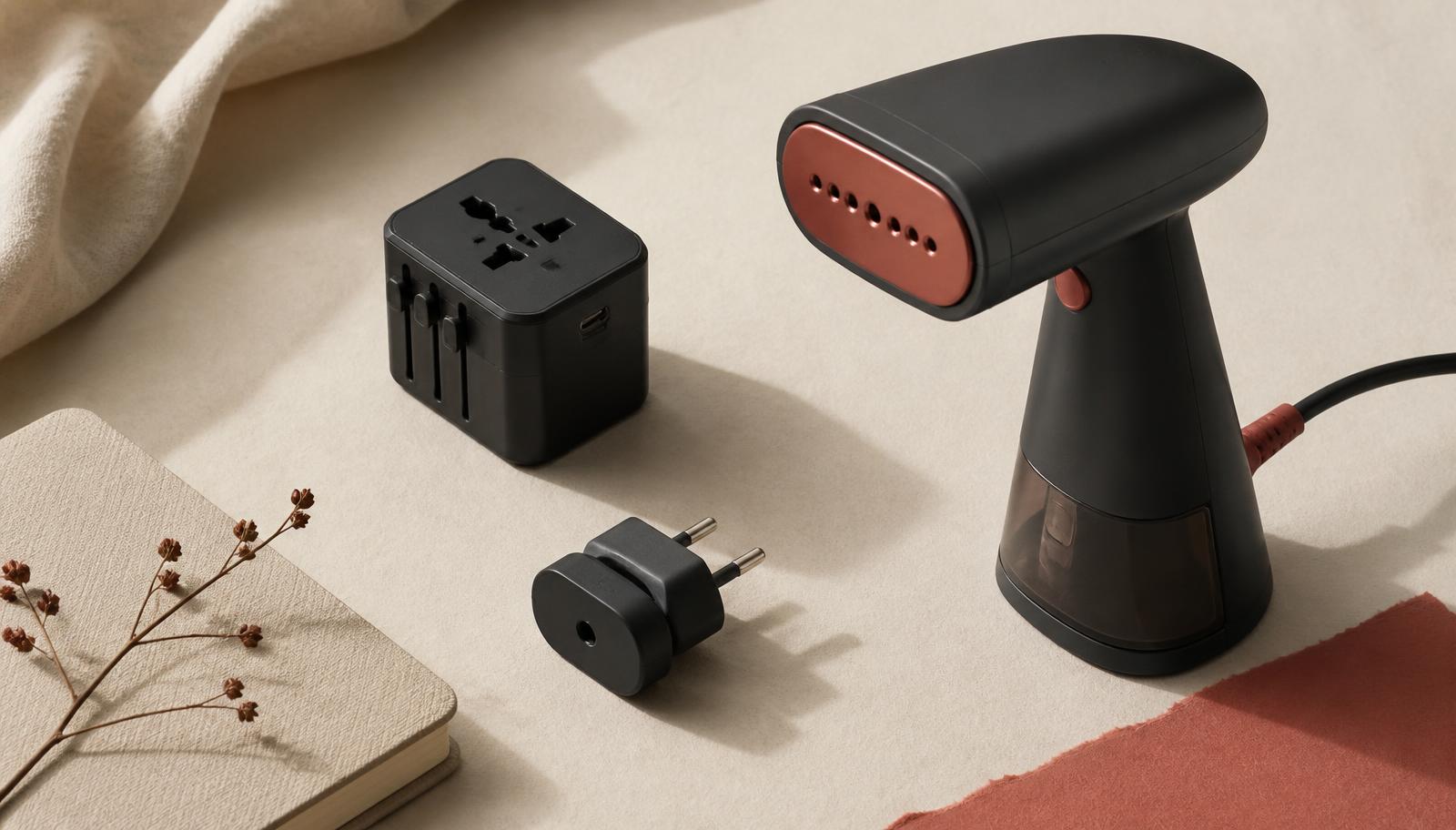
Interactive
Read a voltage label
Every steamer has a rating label on its body or in its manual. Select a label style to see what it means for your trip.
Interactive
Estimate current draw
Amps = watts ÷ volts. Enter the wattage printed on your appliance label and the voltage at your destination.
The short answer: how many watts should a travel steamer have?
There is no single wattage that makes a travel steamer right for every trip. Wattage describes electrical power use. Voltage describes the electrical supply the appliance expects. Start with destination voltage and frequency, then read the exact model's input label. A 120V-only steamer should not be plugged into a 220V or 240V outlet merely because a plug adapter fits. A dual-voltage model must state its supported input range, such as 110-240V.
After electrical compatibility, compare wattage with heat-up time, steam output, tank, runtime, weight, format, and warranty. Higher wattage may mean higher electrical demand. It does not prove faster heat-up or better results on every garment.
Compare dual-voltage travel steamers on Amazon
Quick reference: what the numbers mean
| If you see... | It means... | Do not assume... |
|---|---|---|
120V | The appliance expects a 120V supply | It will work on 220V or 240V power |
220-240V | The appliance expects that stated higher-voltage range | It will work on 120V power |
110-240V | The appliance is rated across that input range | Every plug type is covered |
50/60Hz | The appliance supports the stated frequencies | Wattage or heat-up will be identical everywhere |
1000W or 1100W | The listed electrical power demand | The steamer is automatically stronger or better |
8A | The listed current under the stated conditions | The same amperage applies at every voltage |
The label on the appliance, its power supply, and the manual should settle the question. A marketplace title is not enough.
Voltage, wattage, amps, and frequency in plain English
Voltage, or V
Voltage describes the electrical potential supplied by the outlet. Your steamer must be rated for the voltage it receives. If the destination supply is outside the appliance's documented range, stop and check the manual or ask the manufacturer.
Wattage, or W
Wattage describes how much electrical power the appliance uses. It helps you compare electrical demand and check whether an adapter, converter, transformer, or outlet is suitably rated. It is not a simple score for steam quality.
Amperage, or A
Amperage describes the current flowing through the appliance. When volts and amps are available, you can estimate watts with this relationship:
watts = volts x amps
The appliance label and manual take priority over a rough calculation.
Frequency, or Hz
Frequency describes how often alternating current cycles each second. Common labels include 50Hz, 60Hz, or 50/60Hz. Some simple heating devices may be less sensitive to frequency than clocks or certain motor-driven devices, but the product's rating controls.
Electrical Safety First advises travelers to check socket type, voltage, and frequency before using an appliance abroad. REI also recommends checking the destination supply and the input voltage on each device.
A simple wattage calculation
Suppose a travel steamer is rated at 1100W and the supply is 120V. A rough current estimate is:
1100W ÷ 120V = approximately 9.2A
This is an electrical-load example. It is not permission to exceed the rating of an outlet, travel adapter, converter, transformer, or power strip. The rating of the accessory must support the appliance, and the appliance must be suitable for the destination supply.
The current estimate can change when the same power is delivered at a different voltage. Do not use wattage alone to decide whether a steamer is safe abroad.
Check the destination before you check the steamer
Before comparing models, write down three details for every destination:
- The socket or plug type.
- The nominal voltage.
- The frequency.
REI's world electricity guide lists common destination systems and recommends checking the destination and each device rather than relying on assumptions.
| Destination example | Typical supply to investigate | What to verify before use |
|---|---|---|
| United States and Canada | Around 110-127V | Hotel supply, appliance label, and plug type |
| Much of Europe | Around 220-240V | Country, hotel, frequency, and plug type |
| Japan | Around 100V | Region, appliance rating, frequency, and plug type |
| Australia and New Zealand | Around 230V | Appliance rating, frequency, and Type I plug |
These are broad examples, not a complete country-by-country database. A hotel, cruise ship, or other lodging may have different sockets or restrictions. Confirm the local details before you travel.
An adapter is not a voltage converter
This is the mistake that causes the most confusion.
| Accessory | What it changes | What it does not change |
|---|---|---|
| Plug adapter | The physical prong shape so a plug fits a socket | The voltage coming from the outlet |
| Voltage converter or transformer | The voltage supplied to a compatible appliance | The appliance's design limits, frequency requirements, or every safety issue |
| Dual-voltage appliance | The input range the appliance is designed to accept | The need for a suitable plug adapter |
Electrical Safety First says a travel adapter does not convert voltage. If the supply differs from the appliance rating, a converter or transformer may be needed unless the appliance is dual-voltage rated. Conair's travel-electricity guide makes the same adapter-versus-converter distinction and tells travelers to check the input marking on the appliance.
The practical safety example
A 120V-only travel steamer should not be connected to a 220V or 240V outlet simply because the plug adapter fits. The adapter changes the shape of the connection. It does not change the electricity.
Do not assume that a converter always makes a single-voltage steamer safe. A suitable setup depends on the appliance, wattage, duty cycle, grounding, converter design, and manufacturer instructions. For a high-wattage heating appliance, ask the manufacturer or use a model already rated for the destination.
What does dual voltage actually mean?
A dual-voltage label means the appliance is designed for more than one input voltage. Look for a marking such as INPUT: 110-240V on the appliance or its power supply. You may still need a plug adapter for the destination socket.
The exact notation matters:
| Label example | How to interpret it |
|---|---|
120V | Single-voltage appliance for a 120V system |
220-240V | Single-voltage range for a higher-voltage system |
120/220V | Two stated voltage options; check whether a selector is required |
110-240V | Input range across common low- and high-voltage systems |
A slash, range, selector, or automatic-switching statement may have model-specific meaning. Read the manual rather than guessing.
Confirmed example: Rowenta Origin DR1050U1
Rowenta's official page lists the Origin DR1050U1 as a 120V-240V dual-voltage travel steamer with 1100W power. The same page lists a 25-second heat-up, up to 20g per minute of continuous steam, a 1.57 lb weight, and four minutes of runtime per fill.
The lesson is useful: dual voltage solves one compatibility problem. It does not eliminate trade-offs around runtime, weight, tank, or packed size.
Domestic example: BEAUTURAL Foldable 120V
BEAUTURAL's official store identifies its foldable travel steamer as 1000W and 120V only for the United States and Canada. The store explicitly warns against connecting it to 220V power, even with an adapter.
The lesson is equally important: a product can be foldable and marketed for travel while still being unsuitable for a different voltage system.
For product selection, see the best dual-voltage travel steamers.
How many watts does a travel steamer need?
Compare wattage after electrical compatibility. A higher number can mean greater electrical demand, but it does not settle the questions that matter in a hotel room:
- How quickly does the model heat up?
- How long does one tank last?
- How much steam does the manufacturer state?
- How much does the complete kit weigh?
- Does the device work vertically, horizontally, or at an angle?
- Can you empty the tank before packing?
- Does the format suit shirts, jackets, dresses, trousers, or collars?
Use wattage as one field in a wider comparison rather than as a ranking system.
Product examples
| Model example | Documented power | What the number does and does not tell you |
|---|---|---|
| Rowenta Origin DR1050U1 | 1100W official | Confirmed dual-voltage power. Compare it with the 25-second heat-up and four-minute runtime, not by wattage alone. |
| BEAUTURAL Foldable 120V | 1000W official | A domestic-voltage example. Do not position it as an international model. |
| Steamfast NOMAD | 800W official | Lower listed power with a documented 5oz tank and ten-minute duration. Confirm voltage before international use. |
| NORI Press | 450W/750W electrical statement on official page | A press-format product with model-specific electrical wording. Do not compare it directly with every handheld steamer. |
| Epicka Global Travel Steamer | Wattage not displayed on official page | Do not import a wattage figure from a different model or generic marketplace title. |
Steamfast documents the NOMAD at 800W with a 5oz tank, 30-second heat-up, and ten-minute stated duration. Its voltage should be confirmed in the exact model's owner guide or on the label before international use.
NORI's official sources list 120/220V at 60Hz and a 450W/750W electrical statement. It is a press and steam iron, not a conventional hanging steamer. Its power and water-capacity wording should be handled as model-specific information.
Epicka's official page describes worldwide-voltage compatibility and a 15-second heat-up, but it does not display wattage, weight, or tank capacity in the source reviewed. Leave fields blank rather than filling them from another listing.
Wattage and adapter or converter ratings
Any accessory used with a heating appliance must be rated for the appliance's electrical demand. Electrical Safety First advises travelers to check that an adapter does not exceed its maximum power rating in amps or watts. REI advises checking the converter or transformer rating against the appliance wattage when conversion is appropriate.
Use this order:
- Read the steamer's voltage and wattage label.
- Check the destination supply.
- Decide whether the steamer is already dual voltage.
- If it is single voltage, read the manual before considering conversion.
- Check the adapter, converter, or transformer rating.
- Confirm frequency, grounding, duty cycle, and lodging guidance.
Do not use a low-rated adapter with an 800W, 1000W, or 1100W heating appliance. Do not infer an accessory's safe rating from its product title.
Frequency matters when voltage matches
A voltage match does not answer every electrical question. Check whether the appliance supports 50Hz, 60Hz, or both.
Electrical Safety First notes that a frequency difference can affect how an appliance operates. REI explains that frequency can matter for devices with timing or motor behavior.
Many steamers use heating elements and may be less sensitive to frequency than a clock, but that is not a universal rule. If the destination frequency is outside the model's documented range, ask the manufacturer before use.
Read the whole label, not only the product title
Marketplace titles can combine details from multiple variants. Confirm these fields for the exact model:
| Field | What to check |
|---|---|
| Model number | Match the appliance, listing, manual, and warranty |
| Input voltage | Look for a single value, range, or dual-voltage notation |
| Frequency | Check for 50Hz, 60Hz, or 50/60Hz |
| Wattage | Note whether the source gives one figure or different regional values |
| Selector | Confirm whether the user must switch voltage manually |
| Plug | Check the included plug, adapter, and destination fit |
| Safety | Read grounding, insulation, auto-shutoff, and use-position instructions |
| Support | Confirm the manual, returns, and warranty for the market where you buy |
The Rowenta research shows why this matters. An Amazon listing contained conflicting power figures, while Rowenta's official page resolved the model's power as 1100W. When a marketplace page and a manufacturer page disagree, use the model-specific manufacturer source or mark the field for verification.
A safe buying decision tree
1. Where will you plug it in?
Record the destination voltage, frequency, and plug type. If your itinerary includes multiple countries, repeat the check for each one.
2. What does the exact model accept?
Read the appliance label and manual. Do not rely on the word “travel” in the title.
3. Is it dual voltage?
Confirm the complete input range and whether the model switches automatically or needs a selector.
4. Is an adapter enough?
An adapter is enough for plug shape only when the appliance already supports the destination voltage. If it does not, follow the manufacturer guidance before considering any converter or transformer.
5. Does the rest of the product fit your trip?
Compare wattage, heat-up, runtime, tank, weight, format, cord, warranty, returns, and packed dimensions. Electrical compatibility comes first. It is not the only decision.
Compare current dual-voltage options
Common mistakes to avoid
Mistake 1: Treating an adapter as a converter
A plug adapter changes prong shape. It does not change voltage.
Mistake 2: Choosing the highest wattage automatically
Wattage measures electrical demand. It does not independently prove stronger steam, faster heat-up, or better results.
Mistake 3: Assuming “travel” means dual voltage
A travel steamer can be 120V only. Check the label and manual.
Mistake 4: Transferring data between variants
Do not move the wattage, voltage, tank, or runtime from one model to another. Confirm the exact model number.
Mistake 5: Ignoring frequency
Check the frequency marking when traveling between 50Hz and 60Hz systems.
Mistake 6: Forgetting the adapter's own rating
A plug may fit while the adapter is not rated for the appliance's wattage. Check the accessory rating before connecting a heating appliance.
Frequently asked questions
How many watts should a travel steamer have?
There is no universal ideal wattage. Start with voltage and frequency compatibility. Then compare wattage with heat-up time, steam output, tank, runtime, weight, format, and support. Higher wattage means higher electrical demand, not an automatic guarantee of better garment results.
Is a 120V travel steamer dual voltage?
No. A device marked only 120V is not dual voltage. Look for a model-specific input range such as 110-240V, or a clearly documented 120/220V design with any selector instructions.
Can I use a 120V steamer in Europe with a plug adapter?
Not with a plug adapter alone. A plug adapter changes the prong shape, not the voltage. Do not connect a 120V-only steamer to a 220V or 240V outlet merely because the plug fits. Follow the appliance manual and manufacturer guidance.
Does a higher-wattage steamer heat up faster?
Not necessarily. Wattage describes power use. Heat-up also depends on the design and operating conditions. Use the manufacturer’s heat-up claim for the exact model, and do not turn that claim into a promise about every fabric.
What does 110-240V mean on a travel steamer?
It indicates that the appliance is rated for input across that voltage range. You may still need a plug adapter for the destination socket. Check frequency and any manual selector instructions.
Do I need a converter for a dual-voltage travel steamer?
Usually not for voltage conversion when the appliance is genuinely rated for the destination supply. You may still need a plug adapter. Confirm the model's input range, frequency, and manual before use.
How do I calculate amps from watts?
For a simple estimate, divide watts by volts. An 1100W appliance at 120V is approximately 9.2A. Treat this as an electrical-load example, not permission to exceed an adapter, converter, transformer, power strip, or outlet rating.
Does frequency matter for a travel steamer?
It can. Check whether the appliance is rated for 50Hz, 60Hz, or both. If the destination frequency is outside the documented range, ask the manufacturer.
Do I need a plug adapter if my steamer is dual voltage?
Often, yes. Dual voltage concerns the electrical supply the appliance can accept. It does not guarantee that the appliance's plug fits the destination socket.
Final checklist
Before buying or plugging in a travel steamer, confirm:
- Destination voltage
- Destination frequency
- Destination plug type
- Exact appliance model number
- Appliance input voltage
- Appliance wattage
- Frequency range
- Manual instructions
- Whether a selector switch is required
- Adapter rating
- Converter or transformer guidance, if relevant
- Hotel or lodging restrictions
- Current seller, returns, warranty, and availability
Compare confirmed dual-voltage travel steamers
References
- Electrical Safety First: Travel adaptor advice
- REI Expert Advice: How to Choose Travel Power Adapters
- Conair: Which International Travel Adapter or Power Adapter Do I Need?
- Rowenta Origin Travel Dual Voltage Handheld Steamer
- BEAUTURAL official store
- Steamfast NOMAD official product page
- NORI Press official product page
- Epicka Dual Voltage Global Travel Garment Steamer
Keep reading
Dual-voltage steamers
Compare the best dual-voltage travel steamers for overseas trips. See voltage ranges, plug-adapter needs, heat-up times, weight, tank size, and safety caveats.
Portable steamers
Compare portable travel steamers by packed size, weight, foldability, cord, case, heat-up time, and hotel-room usability. See domestic and international caveats.
Lightweight steamers
Compare lightweight travel steamers by listed weight, packed dimensions, foldability, tank trade-offs, heat-up time, and voltage. Find a low-weight pick for your next trip.

Steamers for suits
Find the best travel steamers for suits, compare voltage and control, and learn how to steam jacket panels, lapels, shoulders, and trousers safely.